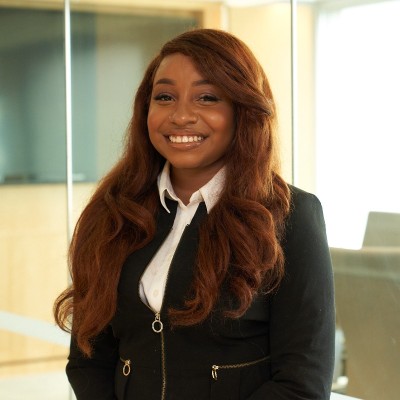
Udodilim Nnamdi, Visiting Scholar and Affiliate Faculty
Udodilim Nnamdi is an international lawyer whose work focuses on reparative justice, international criminal law, and the accountability of states and institutions for racialized mass atrocities. Currently a Staff Attorney at the U.S. Department of Commerce, she previously practiced international law at Foley Hoag’s International Litigation and Arbitration group, representing sovereign governments before the International Court of Justice, ICSID, and the Permanent Court of Arbitration. She also recently served as an Expert Consultant at Georgetown University Law Center’s Center on National Security and has worked with the United Nations International Organization for Migration (IOM) on peace, security, and transitional justice initiatives. Her prior research and advocacy have addressed gender persecution, crimes against humanity, genocide, international environmental law, and reparations for systemic anti-Black violence. Udodilim holds a J.D. from Columbia Law School and an LL.M. in International Criminal Law from the University of Amsterdam where her thesis, Policing Genocide? Evaluating Police Brutality Against Black Americans under International Criminal Law was selected for publication. She has taught and designed courses on protest, justice, and reparations and regularly engages in interdisciplinary scholarship at the intersection of international law, race, and global justice.

Jillian Wechter, Non-Resident Fellow
Jillian Wechter has a background in refugee resettlement, beginning in direct service with newly arrived refugees before overseeing a national portfolio of resettlement programs across the United States. Her work has focused on policy implementation and data analysis to strengthen systems supporting refugees and other displaced communities. Jillian is pursuing a Master of Public Policy at the University of Chicago and holds a bachelor’s degree in Conflict Analysis and Resolution from George Mason University.

Ben Gerstein, Visiting Scholar
Ben Gerstein is a Visiting Scholar at the Mass Atrocities Prevention Program in the Jimmy and Rosalynn Carter School for Peace and Conflict Resolution. He most recently was a Visiting Fellow at the University of Sarajevo Institute for the Research of Crimes Against Humanity and International Law. His current work examines the legal challenges of prosecuting genocide denial and disparate theories which inform post-conflict memory laws. Broadly, Ben deploys historical and legal methodologies to examine the possibilities and restraints of human rights law and international criminal law. His work is either published or forthcoming in the University of Hawai’i Law Review, International Criminal Law Review, Opinio Juris, Just Security, the Law and Political Economy Blog, and Comparative Southeast European Studies. Ben is a graduate of UCLA School of Law and the University of Michigan.

Mike Brand, Visiting Professor
Mike Brand is a human rights, atrocities prevention, and peacebuilding professional with nearly two decades of experience in policy, advocacy, organizing, and education. Throughout his career, Mike has worked for non-governmental organizations (NGOs) in the United States, Rwanda, and South Sudan, and has done fieldwork in the Democratic Republic of the Congo and Uganda. Mike directs the Human Security Project and supports civil society organizations and diaspora networks in strategic planning, program development, and achieving their advocacy and organizing objectives. He is a Non-Resident Senior Fellow at the New Lines Institute for Strategy and Policy, where he is spearheading an initiative to build a prevention-focused foreign policy. He has been published in peer-reviewed journals, national and international publications, and has been quoted in international news outlets as an expert in his field. He has forthcoming chapters in the Routledge Handbook of Genocide Studies (“Genocide in Sudan, 2003-present”) and Intergenerational Survivors of Genocide and Mass Atrocities (“From Gaza to Darfur: Preventing Mass Atrocities Should Never be Controversial”). In addition to his policy and advocacy work, Mike is an Adjunct Professor of mass atrocities prevention and human rights at Georgetown University and the University of Connecticut, and a Visiting Professor at the Mass Atrocities Prevention Program in the Jimmy and Rosalynn Carter School for Peace and Conflict Resolution. Mike is pursuing a PhD in Security Studies with a concentration in mass atrocities prevention. He holds a Master of Arts in International Peace and Conflict Resolution from American University, with a concentration in human rights and atrocities prevention, and Bachelors of Arts in History and Political Science with a minor in human rights from the University of Connecticut.

Noah Fordham, Senior Fellow
Noah Fordham is a Senior Fellow at the Mass Atrocities Prevention Program, with a diverse background spanning national security, military service, intelligence operations, and defense analysis. He earned a Bachelor of Arts in Conflict Analysis and Resolution from George Mason University in 2024. Prior to entering academia, Fordham served on active duty with the 3rd U.S. Infantry Regiment (The Old Guard), where he supported diplomatic engagements and ceremonial missions involving foreign dignitaries and senior government leaders. He later continued his military service in the U.S. Army Reserve as an intelligence professional. His professional experience includes intelligence and national security support for U.S. Special Operations Forces, the U.S. Navy, and the U.S. Marine Corps in the Quantico, Virginia area. He subsequently served as a financial analyst supporting the Department of Defense and currently works as an analyst in the private sector.
Throughout his career, he has contributed to intelligence, counterterrorism, and national security initiatives, including operational missions and engagements in Germany, Canada, and the Balkans. His academic and professional interests focus on international security, intelligence studies, conflict analysis, counterterrorism, and geopolitical developments. His research has examined strategic issues affecting the United States Indo-Pacific Command region, the Horn of Africa, and Europe. As an educator, he seeks to bridge theory and practice by drawing on real-world experience to help students understand contemporary security challenges and the complexities of global conflict.
James P. Finkel, Senior Fellow
Jim Finkel is the co-founder of the Atrocities Prevention Study Group at the Stimson Center in Washington, DC. Finkel ended his 35-year career as a member of the senior civil service in May 2013. During the final 20 years of his service, he held positions that provided him an insider’s eye view of the evolution of U.S. policy toward the prevention of genocide and mass atrocities. Finkel assisted in crafting Presidential Study Directive 10 (PSD 10), which created the Interagency Atrocities Prevention Board, and frequently attended meetings throughout the first year of the Board’s activities. He also served as the Center for the Prevention of Genocide’s Leonard and Sophie Davis Genocide Prevention Fellow from 2013-2014. Finkel holds a Master’s degree in International Affairs from the Johns Hopkins School of Advanced International Studies and a Bachelor of Arts from Rutgers College, Rutgers University.
Past Fellows
Mark Klamberg, Senior Fellow
Mark Klamberg, PhD, has expertise and interests in the fields of international criminal justice, regulation of artificial intelligence, and national security law. He is an affiliated expert with the National School of Judges of Ukraine where he gives advice on the conduct of domestic war crimes trials. Mark is currently Professor and the head of subject for public international law at Stockholm University. Additionally, he serves as deputy director of the Stockholm Centre for International Law and Justice (SCILJ), scholar-in-residence at the School of International Service (SIS), American University, Washington D.C, nonresident Senior Fellow with the Atlantic Council, Washington D.C., expert to the Consultative Council at the National School of Judges of Ukraine to which he gives advice on domestic war crimes trials, available as an expert for OSCE ad hoc missions as part of its human dimensions mechanism (also known as the Moscow mechanism), board member for the Raoul Wallenberg Institute of Human Rights and Humanitarian Law, Lund. Mark acts as a consultant for the Defense in the Al-Hassan case (The International Criminal Court in the Hague). He has also contributed to Government commissioned inquiries, drafting of consultation responses and expert testimony and consultancy in relation to trials in Sweden and at the International Criminal Court (ICC).
Matthew McGrath
Matthew McGrath is a conflict analyst with a background in local journalism. He holds a Master of Science in Conflict Analysis and Resolution from George Mason University, where he was a Scheidt Fellow, and a certificate in Genocide and Mass Atrocity Prevention. He is interested in press freedom, narrative transformation and alternate forms of journalism.
Sara Saghar Birjanidian, Director, Genocide Prevention Network (GPN)
Edwin Daniel Jacob, Postdoctoral Fellow (2018-2020)
Book project while in residence: American Security, the Global “War on Terror,” and the Rise of ISIS. Forthcoming, Routledge.
Charles Hauss, Senior Fellow
Anika Maan, Senior Fellow
Valentyna Polunina, Postdoctoral Fellow (2017-2019)
Book project while in residence: Soviet Contributions to International Law after the Second World War.
Gretchen Sandles, Senior Fellow
Louise Wise, Senior Fellow
Mike Brand, Senior Fellow
Yara M. Asi, Senior Fellow